
When Should Technology Step Back in Forest School?
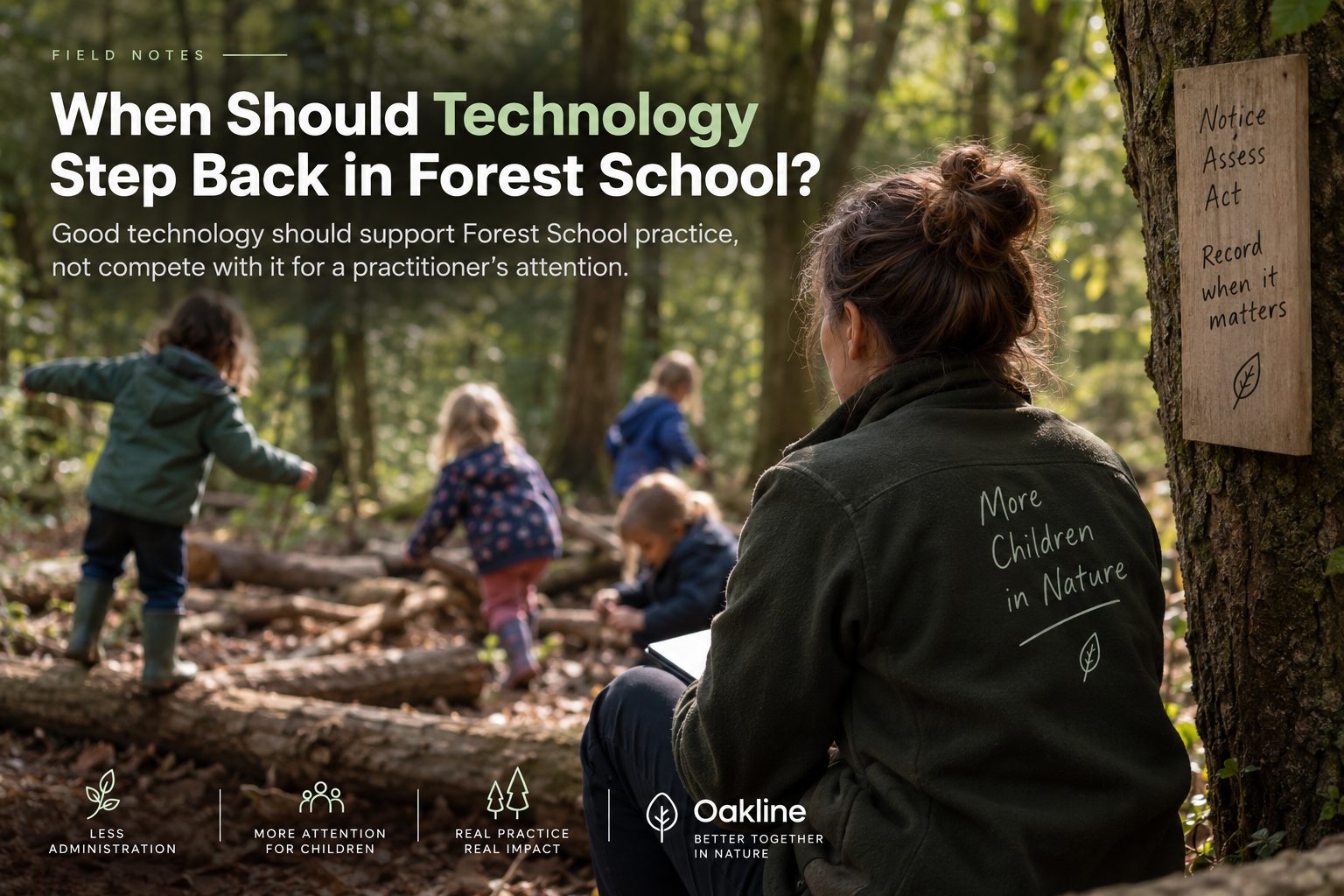
Good technology should support Forest School practice, not compete with it for a practitioner's attention.
Forest School needs records.
It needs planning. Risk management. Registers. Emergency information. Observations. Accident records. Reflection.
Technology can make all of those things easier.
But there is an important question that is rarely asked:
When should the technology step back?
A Forest School session is not an administrative environment.
Children are climbing, exploring, using tools, negotiating relationships, testing ideas, taking supported risks and responding to an environment that can change around them.
Practitioners are observing, facilitating, supporting, making judgements and sometimes responding immediately to situations.
Their attention matters.
So perhaps the measure of good Forest School technology should not be how many things a practitioner can record during a session.
Perhaps we should also ask how many things they need to.
Forest School is built around attention
The Forest School Association identifies practitioner observation as an important element of Forest School pedagogy.
Those observations help practitioners understand learners' needs and motivations and inform how future experiences are scaffolded and adapted.
But observation begins with something very simple:
paying attention.
A practitioner watching a child repeatedly attempt to tie a knot may notice persistence.
Watching a group construct a shelter may reveal negotiation, leadership, frustration and cooperation.
Watching a learner approach a climbing challenge may reveal how they judge their own capabilities and risk.
None of those observations begin with a screen.
They begin with the practitioner being present.
Observation and documentation are not the same thing
This distinction matters.
A practitioner can observe something without immediately documenting it.
Documentation can happen:
- immediately, when appropriate
- a few minutes later
- during a natural pause
- at the end of the session
- during reflective practice afterwards
The right moment depends on what has happened and why the information needs recording.
There will certainly be occasions when making a quick note during a session is useful.
But the ability to record something immediately does not automatically create a requirement to do so.
That second question changes the conversation considerably.
What is dynamic risk assessment?
Dynamic risk assessment is the continuous process of noticing changing conditions, assessing what they mean and responding appropriately while an activity is taking place.
It happens through professional judgement in real time.
A practitioner notices that the wind has increased.
A branch has fallen across part of the site.
The ground has become unexpectedly slippery.
A child's ability or behaviour changes the level of support they need with a tool.
The practitioner assesses what has changed and decides what to do.
They may adapt the activity, increase supervision, move the group, remove a hazard, stop an activity or decide that no intervention is necessary.
That process is the dynamic risk assessment.
It is important to distinguish this from documenting the assessment.
The Forest School Association expects Forest School Leaders to maintain a stated approach to dynamic risk assessment alongside site risk assessments, daily risk assessments and Risk-Benefit Assessments.
That makes dynamic assessment an important part of Forest School practice.
But assessing dynamically and documenting dynamically are two different things.
A digital system may provide a way to record a dynamic risk decision while a session is taking place.
That can be useful.
But the existence of a real-time recording feature should not lead us to confuse the professional process with the administrative record of that process.
Imagine that the wind suddenly increases and makes the current fire location unsuitable.
The practitioner does not make the situation safer by opening a form.
They make it safer by recognising the change, assessing its significance and responding appropriately.
They might extinguish the fire, move people away, relocate the activity or take another appropriate action.
Once the situation is under control, a significant change or decision can be documented at an appropriate time if a record is required.
Action and recording have different purposes
Consider another example.
A child falls and requires first aid.
Nobody would reasonably argue that the first task should be completing the accident record.
The sequence is obvious:
respond to the child first.
Make the situation safe.
Provide appropriate care.
Get additional help if necessary.
Communicate with the appropriate people.
Then, when the immediate situation is under control, create the necessary record.
The record matters.
It provides evidence, accountability and history.
But the record and the response perform different functions.
This distinction is consistent with a proportionate approach to risk management.
The Health and Safety Executive's guidance on children's play emphasises controlling real risks while preserving the benefits of play, rather than allowing paperwork itself to become the focus.
The same question applies to Learning Journeys
Forest School observation is valuable precisely because practitioners notice things.
A child tries something for the first time.
A learner who normally avoids a particular challenge chooses to attempt it.
A friendship develops.
A child finds their own solution to a problem.
A practitioner notices a change in confidence or independence.
These can become meaningful observations in a Learning Journey.
But imagine turning every valuable observation into an immediate administrative instruction:
Stop. Take out the phone. Find the child. Open the record. Type the observation. Save it. Return to the session.
Something has changed.
The practitioner is no longer simply observing the experience.
For that moment, they have stepped out of it to document it.
Sometimes that trade-off will be worthwhile.
Sometimes it will not.
This does not make documentation less important.
It simply recognises that noticing, understanding and recording an experience are related activities, but they do not necessarily need to happen simultaneously.
"Offline" does not answer this question
Offline capability can be extremely valuable in Forest School.
Woodlands often have unreliable mobile signal.
Practitioners may still need access to critical information such as:
- the register
- medical information
- allergies
- dietary requirements
- SEND information
- regulation strategies
- emergency contacts
- consent
- existing risk information
That information can matter immediately.
Being able to mark attendance or capture an important record without signal can also be useful.
But there is an important distinction:
Making an administrative task technically possible offline does not establish that the task needs to happen during the session.
These are separate questions.
Question one
Can I access or record this without internet?
Question two
Do I need to access or record this right now?
A good system should answer the first question.
Good practice should answer the second.
Some information has immediate operational value
This does not mean practitioners should put their phones away and never use technology during Forest School.
That would simply replace one extreme with another.
Some information has obvious immediate value.
If a child is having an allergic reaction, relevant medical information matters now.
If a practitioner needs to contact a parent in an emergency, the emergency contact matters now.
If somebody needs to know whether a child has a particular support strategy, that information may matter now.
If the group is assembling and attendance needs confirming, the register matters now.
Technology can make these things considerably easier.
Not every record belongs at the same point in the workflow
We often talk about "digital records" as though they were one category.
They are not.
Consider these examples:
Register
Its immediate purpose is operational.
We need to know who is present.
Medical information
Its value can become immediate when a practitioner needs to understand or respond to a child's needs.
Emergency contact
It may be required urgently.
Risk-Benefit Assessment
It informs planning and provides context for professional judgement.
Dynamic risk decision
The assessment and response happen in real time.
Documentation may follow when appropriate.
Accident record
The event may require an immediate response.
The formal record follows that response.
Learning Journey observation
The observation happens in the session.
Documentation can happen when it best supports both the learner and the practitioner.
Once we separate these purposes, "everything available and recordable in real time" stops being a particularly useful measure of quality.
More real-time recording is not automatically better record keeping
There is an understandable appeal to contemporaneous records.
Details can be forgotten.
Times can become approximate.
Memories are imperfect.
For some records and circumstances, documenting promptly is important.
But promptly and immediately while the situation is unfolding are not synonyms.
There is a balance.
Waiting too long can reduce accuracy.
Recording too soon can divert attention from something more important.
Professional practice involves judging that balance.
Technology should reduce administrative load, not relocate it
Digital systems have removed enormous amounts of administration.
Parents can provide information themselves.
Registers can be generated automatically from bookings.
Payments can reconcile automatically.
Records can follow a child between sessions.
Information can be available without carrying folders into the woodland.
Observations can become part of a continuing Learning Journey.
Reports can be generated without rebuilding spreadsheets.
These are meaningful improvements because technology is doing work around the practitioner.
There is a danger, however, when digitisation simply moves administration from the office into the woodland.
A paper form completed after a session has not necessarily been improved if the practitioner is now expected to complete the same administrative task on a phone while supervising children.
The form has become digital.
The workload has not disappeared.
It has simply changed location.
A useful test for Forest School technology
When considering whether something should become a real-time digital workflow, ask five questions.
1. Does this information affect something happening now?
If yes, immediate access may be important.
2. Does recording it now improve the outcome?
Not merely the record.
The outcome.
3. What happens if it is recorded at the next appropriate pause instead?
If nothing meaningful is lost, immediate recording may not be necessary.
4. What does the practitioner stop doing while interacting with the system?
Attention has a cost.
That cost should be part of the assessment.
5. Could the technology remove this administrative step altogether?
This may be the most interesting question.
The best digital workflow is sometimes not a faster form.
It is not needing to complete the form at all because the relevant information already exists or the system has handled the administrative process automatically.
There is a place for technology in the woodland
The conclusion is not that phones, tablets or software do not belong in Forest School.
They can be extremely useful.
The conclusion is that technology should have a clear reason for being there.
Give practitioners critical information when they need it.
Allow essential records to be captured when appropriate.
Work without signal where the environment demands it.
Reduce duplication.
Connect information that would otherwise be fragmented.
Automate administration where possible.
And then get out of the way.
Forest School is a human practice.
Its most important moments happen between learners, practitioners and the natural environment.
Technology should make those moments easier to support — not create another thing competing for attention.
Sources & further reading
How Oakline approaches this
Oakline is designed around the idea that technology should reduce administration around a Forest School session rather than create more administration inside it.
Before a session, bookings, family information, payments, registers and Risk-Benefit information are already connected. In the field, practitioners can access critical information such as attendance, medical details, allergies, dietary requirements, SEND information, regulation strategies, emergency contacts, consent and existing RBAs, including when mobile signal is unavailable.
Where recording in the field is useful, supported records such as attendance, accident information and Learning Journey observations can also be created offline and synchronised later.
But Oakline does not assume that because something can be recorded in the woodland, it should interrupt the session.
The aim is simple: make important information available when practitioners need it, automate administration wherever possible, and leave practitioners with more time and attention for the children in front of them.