
What information should Forest School practitioners have with them during a session?
A practical guide to what staff need to know, what they need to be able to access, and what can wait until later.
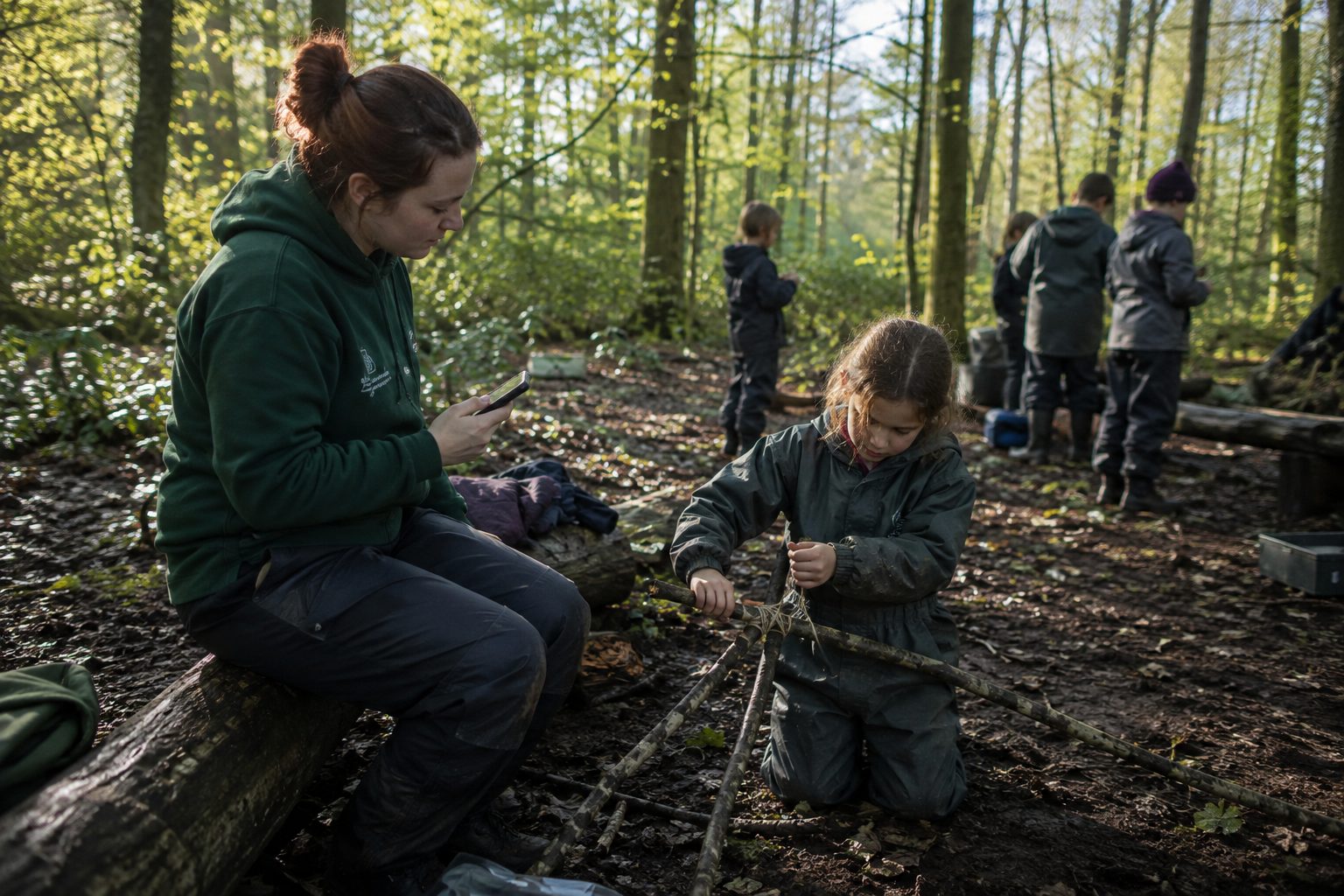
A Forest School session can change quickly.
A child may suddenly feel unwell. Someone may mention an allergy that needs checking. A practitioner may need to understand why a child is becoming overwhelmed, contact a parent, confirm whether a photograph can be used, or revisit the Risk-Benefit Assessment for an activity.
In those moments, the important question is not whether every piece of information about the child or session is available.
It is whether the right information is available when it is needed.
There is also a difference between information practitioners should know before a session begins, information they may need to access during the session, and information that can reasonably be recorded or completed afterwards.
Understanding that difference can help Forest School settings keep practitioners informed without turning a woodland session into an administrative exercise.
Think about information in three stages
A useful way to approach session information is to divide it into three groups:
- what practitioners should know before the session
- what they should be able to access during the session
- what may need to be recorded during or after the session
These groups overlap, but they are not the same.
A practitioner should already understand the important risks, individual needs and emergency procedures before children arrive. During the session, however, they may still need quick access to specific details.
And although some events need to be recorded, that does not necessarily mean the record should be completed at the exact moment the event occurs.
Who are we responsible for right now?
One of the most basic pieces of information is also one of the most important: who is actually attending the session?
Practitioners need an accurate register showing which children are expected and which children are present.
This becomes particularly important when:
- children arrive or leave at different times
- several groups are operating
- responsibility is transferred between adults
- an emergency or evacuation occurs
- staff need to confirm that everyone is accounted for
A booking list and an attendance register are related, but they are not necessarily the same thing.
The practical question during a session is not simply who booked?
It is:
Who are we responsible for right now?
Medical information and allergies
Practitioners may need immediate access to relevant medical information.
This can include:
- allergies
- medical conditions
- medication information
- dietary requirements where relevant to the activity
- important instructions provided by the family
- other information necessary to respond safely to the child's needs
Not every detail in a child's complete administrative record needs to be carried into the woodland.
The information available to practitioners should be relevant to their role and to the session.
Health information is also sensitive personal data. Under UK GDPR, data concerning health is treated as special category data and requires additional protection.
This means accessibility and privacy need to be considered together.
Practitioners need access when there is a legitimate operational need, but sensitive information should not simply be made available to everyone.
SEND and individual support information
A diagnosis or label alone may tell a practitioner very little about how to support a particular child.
Useful information can be much more practical.
Depending on the child, practitioners may need to understand:
- known triggers
- sensory needs
- communication preferences
- regulation strategies
- calming strategies
- relevant behavioural or emotional support information
- agreed adjustments
- specific support arrangements
The important question is:
What does the practitioner need to know to support this child appropriately today?
Good records should help practitioners understand the child rather than simply describe them.
Emergency contacts
If something happens, practitioners need to know how to contact the appropriate person.
Current Department for Education guidance for parents using out-of-school settings recommends that providers have emergency contact information and that parents share relevant medical concerns and allergies with the setting.
Depending on the provision, practitioners may need access to:
- parent or carer name
- primary emergency contact
- additional emergency contact where available
- relevant contact numbers
- other emergency information required by the setting
There is an important operational consideration here.
Emergency information is only useful if it can actually be accessed during an emergency.
If a session takes place somewhere with unreliable mobile data, storing the only accessible copy behind an internet connection creates an obvious practical weakness.
Risk information should support judgement
Risk is an inherent part of Forest School practice.
The Forest School Association describes supported risk-taking as an important part of Forest School. Its principles and criteria for good practice emphasise Risk-Benefit processes appropriate to the environment, learner and developmental stage.
Practitioners should therefore understand the relevant Risk-Benefit information before the session.
They may also need to consult it again during delivery.
But a Risk-Benefit Assessment does not replace professional judgement.
Conditions change.
Children behave differently.
Weather changes.
A branch may fall.
An area that was suitable earlier may become unsuitable later.
This is where dynamic risk assessment and practitioner judgement remain important.
If an immediate hazard appears, the first priority is usually to deal with the situation appropriately.
A practitioner does not need to complete a digital form before moving children away from a newly identified hazard.
Action comes before administration when immediate action is required.
Emergency procedures should be understood before the emergency
Emergency procedures are different from information that practitioners might occasionally look up.
Staff should already understand the setting's emergency arrangements before they need them.
Depending on the setting and location, this may include:
- what to do in a serious injury or medical emergency
- how emergency services would access the site
- evacuation or meeting points
- who takes responsibility for the group
- how parents or carers are contacted
- who is responsible for making key decisions
- what happens if normal communication methods are unavailable
The Department for Education publishes guidance on emergency planning and response for education, childcare and relevant children's settings.
Photo and media consent
If photographs are taken during Forest School sessions, practitioners need to understand what consent has actually been given.
This is not always as simple as:
Photo consent: Yes / No
A family may be comfortable with photographs being used for one purpose but not another.
For example:
- internal records
- a child's Learning Journey
- the provider's website
- social media
- printed promotional materials
Where a setting distinguishes between these purposes, practitioners need enough information to make the correct decision when taking or using photographs.
Consent information should therefore be clear enough to be useful in practice.
What actually needs to be recorded during the session?
Not everything needs to be recorded immediately.
There is a meaningful difference between:
- information that needs to be available
- something that needs to be acted upon
- something that needs to be recorded
Consider an accident.
The immediate priority is the child.
The practitioner may need to:
- assess what has happened
- provide appropriate first aid
- make the area safe
- reassure the child
- manage the rest of the group
- contact a parent or emergency service where necessary
The accident still needs to be recorded appropriately.
But completing the administrative record should not take priority over caring for the child.
The same principle can apply to other records.
Good record keeping matters, but the purpose of the record is to support safe, accountable and reflective practice — not to distract practitioners from the children in front of them.
Observations are different
Observations have a different purpose.
The Forest School Association describes Forest School as a long-term process involving a cycle of planning, observation, adaptation and review.
An observation may therefore be useful because it informs what happens next.
A practitioner might notice:
- a child attempting something independently for the first time
- a change in confidence
- social interaction
- problem solving
- emotional regulation
- an emerging interest
- a new approach to risk
Capturing that observation can contribute to understanding the child's journey over time.
But again, professional judgement matters.
Not every moment needs to become data.
Sometimes the practitioner should simply be present.
What happens when there is no mobile signal?
This question becomes particularly important for Forest School because sessions often take place precisely where connectivity is unreliable.
Woodland, rural sites and outdoor environments can have weak or nonexistent mobile data.
A useful distinction is:
Internet access is not the same as information access.
A practitioner may not need the internet during a session.
They may, however, need information that would normally be retrieved through it.
Relevant information that may need to remain available can include:
- the register
- attendance
- relevant medical information
- allergies
- dietary requirements
- emergency contacts
- SEND information
- triggers and regulation strategies
- photo and media consent
- relevant Risk-Benefit information
Offline capability should therefore be considered as part of operational planning where connectivity cannot be relied upon.
More information is not automatically better
It can be tempting to solve information problems by giving practitioners access to everything.
That creates a different problem.
Too much information can make important information harder to find and may create unnecessary privacy exposure.
UK data protection principles include data minimisation: personal information should be adequate, relevant and limited to what is necessary for the purpose.
The Information Commissioner's Office provides guidance on children's information and the additional considerations involved when processing children's personal data and special category information such as health data.
A useful design question for any Forest School information system is therefore:
What does this practitioner genuinely need in order to support this child and deliver this session safely?
Not:
How much information can we put on the screen?
A practical no-signal check
Before your next session, imagine that mobile data disappears as soon as you enter the site.
Could the practitioners responsible for the children still determine:
- who should be there?
- who is actually present?
- whether a child has a relevant medical condition?
- whether there are allergies or dietary requirements they need to know about?
- whether a child has additional needs, known triggers or useful regulation strategies?
- who should be contacted in an emergency?
- what photo or media consent applies?
- what Risk-Benefit information applies to the session?
- what the emergency arrangements are?
If the answer to one of those questions is no, it may be worth reviewing how that information is made available.
Technology should make important information easier to reach
There is a useful role for technology in Forest School.
It can reduce duplicated paperwork, connect information, maintain records and make relevant information available to the people who need it.
But technology is supporting the session.
It is not the session.
A good system should make important information easier to reach without demanding unnecessary attention from practitioners.
The objective is not to transport the office into the woodland.
It is to ensure that practitioners are prepared, informed and able to concentrate on the children in front of them.
The information should be there when it matters.
And when it doesn't, it should stay out of the way.
Sources & further reading
How Oakline approaches this
Oakline is designed so that critical session information remains available to authorised practitioners in the field, including when mobile signal is unavailable.
Its offline field capability includes the register, attendance, relevant medical information, allergies, dietary requirements, emergency contacts, SEND information, triggers and regulation strategies, photo consent and existing Risk-Benefit Assessments.
Practitioners can also continue recording attendance, accident information and Learning Journey observations while offline, with supported changes synchronising when connectivity returns.
The aim is not to make practitioners run a Forest School through a screen. It is to make the information and records they genuinely need available when they need them, while allowing their attention to remain where it belongs: on the children and the session.