
Risk Assessment vs Risk-Benefit Assessment: What's the Difference in Forest School?
Both consider risk, but they ask slightly different questions. Here's how Risk-Benefit thinking fits into Forest School practice.
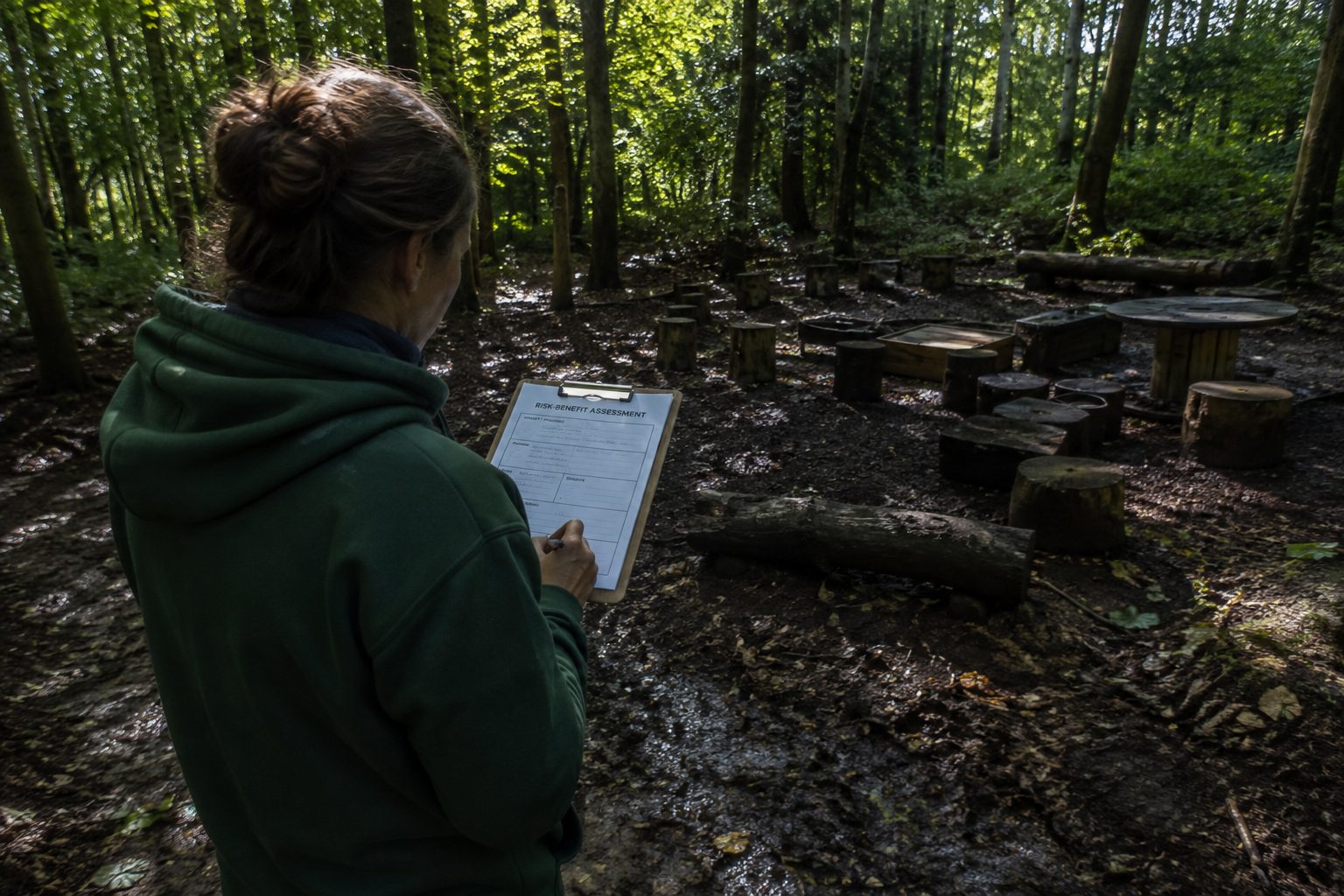
Risk is not an unfortunate side effect of Forest School.
Learning to encounter, understand and manage appropriate risk is part of the experience.
A child balancing on a fallen log could fall. A child using a hand tool could cut themselves. Fire introduces obvious hazards. Uneven woodland, climbing, carrying heavy natural materials and exploring unfamiliar spaces all involve some degree of uncertainty.
It would be possible to remove many of these risks.
But doing so could also remove something valuable.
That is where Risk-Benefit Assessment becomes particularly relevant to Forest School.
A conventional Risk Assessment and a Risk-Benefit Assessment are closely related. Both require practitioners to identify hazards, consider who may be harmed and make sensible decisions about controls.
The important difference is that Risk-Benefit thinking also asks:
What might the learner gain from this experience, and what might be lost if we remove the risk entirely?
What is a Risk Assessment?
At its simplest, a Risk Assessment is a structured way of thinking about potential harm.
It might consider questions such as:
- What is the hazard?
- Who could be harmed?
- How could they be harmed?
- How likely is that harm?
- How serious could it be?
- What controls are already in place?
- Are additional controls needed?
- Is the remaining risk acceptable?
This is an important process.
Forest School does not sit outside normal health and safety responsibilities simply because risk is part of its ethos.
There are hazards that should be removed, controlled or avoided.
A damaged tool, an unstable dead branch over a gathering area, unsafe equipment or an environmental hazard with no meaningful learning benefit should not be preserved simply to provide children with "risk".
Risk-Benefit thinking does not change that.
What it changes is the way we think about risk that is connected to a meaningful experience.
What does Risk-Benefit Assessment add?
Consider a child climbing a tree.
A conventional assessment naturally considers the possibility of falling.
That matters.
But if our only objective were to reduce the possibility of a fall as close to zero as possible, the simplest control might be:
Do not allow children to climb trees.
The risk has been dramatically reduced.
But something else has disappeared too.
Tree climbing may offer opportunities for:
- balance and coordination
- physical strength
- spatial awareness
- confidence
- decision-making
- problem solving
- judging height and distance
- understanding personal limits
- learning to assess risk
- experiencing challenge and achievement
Risk-Benefit Assessment brings those considerations into the decision.
Instead of asking only:
How can we remove the possibility of falling?
we can also ask:
What does the child gain from this experience, and how can we preserve those benefits while managing the significant risks sensibly?
That is a very different conversation.
Risk-Benefit does not mean "the benefit justifies the risk"
This distinction is important.
Risk-Benefit Assessment should not become a mechanism for rationalising an unsafe activity.
Finding a possible benefit does not automatically make a risk acceptable.
There may be situations where:
- the potential harm is too severe
- the likelihood is unacceptable
- conditions have changed
- equipment is unsuitable
- the environment is unsuitable
- adequate supervision cannot be provided
- the activity is inappropriate for the particular learner
- reasonable controls cannot reduce the risk sufficiently
In those circumstances, the correct decision may still be to modify, postpone or stop the activity.
The Forest School Association's Risk Principle
The Forest School Association places supported risk-taking directly within its principles and criteria for good practice.
Its Risk Principle states that Forest School offers learners opportunities to take supported risks appropriate to the environment and to themselves.
The FSA also describes a Risk-Benefit process that is managed jointly by practitioner and learner and tailored to the learner's developmental stage.
That last point matters.
Risk is not simply a property of an activity.
It also relates to the individual experiencing it.
The same activity may represent a very different level of challenge for two children.
A learner who has spent months developing confidence and competence with a particular tool is not necessarily in the same position as a learner encountering that tool for the first time.
Similarly, a height that feels manageable to one child may feel overwhelming to another.
Supported risk therefore requires more than a generic document.
It requires practitioners to know their learners.
What does the HSE say about risk and children's play?
This way of thinking is not unique to Forest School.
The Health and Safety Executive has explicitly supported a balanced approach to risk in children's play and leisure.
Its guidance recognises that play is important for children's development and that the goal when providing play opportunities is not to eliminate all risk, but to weigh risks and benefits.
The HSE also makes an important distinction between meaningful risk and unnecessary danger.
Providers should focus on controlling real and significant risks while avoiding unnecessary restrictions that remove beneficial challenge.
That means sensible risk management is not about creating an environment where nothing can go wrong.
Nor is it about producing the largest possible amount of paperwork.
It is about making proportionate decisions.
Risk and hazard are not quite the same thing
It is also useful to distinguish between a hazard and risk.
A hazard is something with the potential to cause harm.
Risk considers the likelihood and potential severity of that harm in the circumstances.
Fire, for example, is a hazard.
But the risk presented by fire depends enormously on context.
A poorly controlled fire in inappropriate conditions is very different from a carefully managed fire activity with appropriate boundaries, supervision, competence and procedures.
A tool has the potential to cause injury.
But the risk involved in using that tool depends on factors such as:
- which tool is being used
- its condition
- how it is being used
- the activity
- the learner's competence
- practitioner supervision
- positioning
- environmental conditions
This is one reason why simply labelling something "dangerous" tells us relatively little about how it should be managed.
Tools are a useful example
Traditional hand tools are an established part of many Forest School programmes.
The Forest School Association's guidance on hand tools places responsibility on the Forest School Leader to introduce tools appropriately to the individual participant and task, when that participant is ready.
It also emphasises appropriate Risk or Risk-Benefit Assessments and safe tool policies and procedures.
The potential for harm is real.
That does not mean the appropriate response is necessarily to remove tools.
Instead, practitioners might consider:
- whether the learner is ready
- whether the tool is appropriate
- whether the tool is in safe condition
- whether the practitioner is competent
- how the activity is introduced
- positioning and working space
- supervision
- how competence develops over time
What about fire?
Fire makes the same distinction particularly clear.
There are obvious potential benefits to carefully managed fire experiences.
Depending on the programme and learners, these might include:
- responsibility
- confidence
- practical skills
- understanding fire behaviour
- cooking
- cooperation
- patience
- respect for hazards
There are also obvious hazards.
Risk-Benefit thinking means neither ignoring those hazards nor automatically deciding that fire is too dangerous.
It means considering whether the experience is appropriate and, if so, what controls and conditions are necessary.
The Forest School Association specifically states that tools and fires should be used only where appropriate to the learners and dependent on completion of a baseline risk assessment.
Site, daily and activity assessments do different jobs
Risk management in Forest School is not necessarily one document.
The Forest School Association's criteria refer to several elements, including:
- site risk assessment
- daily risk assessment
- Risk-Benefit Assessments
- a stated approach to dynamic risk assessment
- Health and Safety policy
- emergency plans
These address different questions.
A site assessment may identify relatively persistent characteristics and hazards of the woodland or natural environment.
A daily assessment can consider what has changed today.
For example:
- weather
- storm damage
- fallen branches
- flooding
- damaged structures
- site access
- new environmental hazards
A Risk-Benefit Assessment may consider a particular activity or experience and the relationship between its risks, controls and benefits.
And then there is what happens when the session actually begins.
Written assessment and dynamic risk assessment
No written assessment can predict every event in a Forest School session.
Woodland changes.
Weather changes.
Groups change.
Children make unexpected decisions.
A branch falls.
A path becomes slippery.
A child who was confident yesterday may be tired or dysregulated today.
A practitioner therefore continues assessing circumstances throughout the session.
This is commonly described as dynamic risk assessment.
Dynamic assessment does not make written assessment unnecessary.
And written assessment does not make dynamic judgement unnecessary.
They perform different roles.
This is why a good risk-management system should support practitioner judgement rather than attempt to replace it.
Children can be part of the process
One particularly important aspect of the Forest School approach is that risk management does not have to be something adults do invisibly to children.
The Forest School Association describes the Risk-Benefit process as being managed jointly by practitioner and learner, tailored to the learner's developmental stage.
That creates opportunities for children to develop their own understanding of risk.
A practitioner might ask:
- What do you notice here?
- What could happen?
- Does that branch feel strong?
- Where could you put your feet?
- What space do you need around you?
- What could make this safer?
- Do you feel ready to try this?
- What will you do if it becomes uncomfortable?
The objective is not simply compliance with adult instructions.
Over time, children can develop greater capacity to recognise hazards, judge their abilities and make decisions.
That learning itself can be one of the benefits being considered.
Risk-Benefit is not about scoring everything
Some risk-management systems rely heavily on numerical matrices.
Likelihood multiplied by severity.
Red, amber and green boxes.
These tools can be useful where they help people make consistent decisions.
But the number itself should not become the objective.
Two activities can receive similar numerical scores while presenting very different contexts, benefits and decisions.
Professional judgement still matters.
The HSE's approach to children's play emphasises sensible and proportionate control of real risks rather than unnecessary paperwork.
That is particularly relevant to Forest School.
A beautifully completed risk matrix does not make poor practice safe.
And a practitioner does not become competent simply because every box has been filled in.
What should a useful Risk-Benefit Assessment contain?
There is no single universal layout that every Forest School must use.
A useful RBA might, depending on the setting and activity, help practitioners understand:
- the activity or experience being considered
- the potential benefits
- significant hazards
- who may be affected
- relevant control measures
- factors that may change the risk
- any specific considerations for individual learners
- circumstances in which the activity should be modified or stopped
- review information
- who completed or reviewed the assessment
The important test is not how impressive the document looks.
It is whether it helps practitioners make better-informed decisions.
If the answer is yes, the document is probably doing something useful.
If it exists only because somebody expects a form to exist, it may be worth reconsidering how the assessment is being used.
When should an RBA be reviewed?
Risk-Benefit Assessments should not be treated as documents that are written once and forgotten.
A review may be appropriate when, for example:
- the activity changes significantly
- the site or environment changes
- equipment changes
- an accident or near miss raises a new concern
- practitioners identify a control that is not working
- new learners introduce different considerations
- professional practice or guidance changes
- experience shows that the original assessment no longer reflects reality
Not every change requires rewriting everything.
But the assessment should continue to represent the activity that is actually being delivered.
A practical way to think about it
When considering a Forest School experience, try asking the questions in this order:
1. What is the value of this experience?
What might the learner gain?
2. What could cause meaningful harm?
Focus on real hazards rather than every imaginable possibility.
3. Who is involved?
Consider the particular learners, not only an abstract "child".
4. What sensible controls are appropriate?
Controls should manage significant risk without unnecessarily destroying the value of the experience.
5. What could change?
Weather, environment, group dynamics and individual circumstances matter.
6. What will require practitioner judgement during the session?
Not everything can be decided in advance.
7. Is the remaining risk proportionate to the benefit?
Sometimes the answer will be yes.
Sometimes the activity should be modified.
And sometimes the correct answer is no.
That is professional judgement.
The paperwork is evidence of the thinking — not a substitute for it
Risk-Benefit Assessment is sometimes discussed as though the document itself were the safety mechanism.
It isn't.
The real process involves:
- knowledge
- preparation
- observation
- competence
- communication
- appropriate controls
- understanding individual learners
- responding to changing conditions
- professional judgement
The written assessment helps make that thinking visible, consistent and reviewable.
But the quality of Forest School practice still depends on what practitioners actually do.
That distinction sits close to the heart of Forest School.
Children do not need a world without risk.
They need opportunities to encounter challenge with practitioners who understand the environment, understand their learners and know when to support, when to adapt and when to stop.
Sources & further reading
How Oakline approaches this
Oakline allows Forest School providers to create structured Risk-Benefit Assessments and attach them directly to the sessions where they are relevant.
Reusable RBA templates can reduce repeated administration, while the session-specific assessment remains available to practitioners from the register. Existing RBAs can also be consulted during supported offline field use when mobile signal is unavailable.
Where appropriate, a parent-safe view can make relevant Risk-Benefit information available during the booking journey.
The aim is not to replace dynamic assessment or practitioner judgement with a form. Oakline keeps the prepared information connected to the session so practitioners can access it when useful, while the decisions made in the woodland remain professional decisions made by the people delivering the session.